How Often Should You Test Your Pool Water? A Coffs Harbour Guide
Test your pool water at least once a week from spring through autumn, fortnightly in the cooler months, and always within a day of heavy rain, a storm or a pool party. Summer downpours and strong UV shift water chemistry fast on the Coffs Coast, which is why our Coffs Harbour pool cleaning team tests water at every visit.
How Often Should You Test Your Pool Water?
Clear water doesn't always mean balanced water. Weather, swimmers and chemicals constantly shift your pool's chemistry, and routine testing catches those changes early. Use this schedule as your baseline:
| Season | Pool use | Recommended testing frequency |
|---|---|---|
| Summer (Dec–Feb) | Regular swimming | Weekly, twice weekly in heatwaves |
| Spring and autumn | Weekend use | Weekly |
| Winter (Jun–Aug) | Light or no use | Fortnightly |
| Any season | After a storm or heavy rain | Within 24 hours |
| Any season | After a party or heavy use | The next day |
| Any season | Full professional test | Monthly, and at the start of swim season |
Why Regular Water Testing Matters
Consistent testing forms the foundation of healthy pool care. When your pool's chemical balance shifts even slightly, the effects appear quickly as cloudy water, irritated skin or algae on walls, floors and steps. Balanced water also helps every treatment product work as intended.
Swimmer comfort depends heavily on stable pool pH levels and chlorine. When pH rises too high, chlorine becomes less effective. When pH drops too low, the water irritates eyes and skin. Low chlorine lets bacteria multiply, especially in warm weather or during heavy use, while too much chlorine creates a harsh swim.
Unbalanced water damages equipment too. Low calcium can strip minerals from pool surfaces, high calcium causes scale inside pipes and heaters, and incorrect pH corrodes metal parts and roughens tiles and steps. Regular testing catches these problems early:
- Early detection stops algae before it spreads.
- Accurate readings prevent chemical overuse, which wastes money and irritates swimmers.
- Balanced water extends the life of pumps, heaters, chlorinators and surfaces.
What A Pool Water Test Actually Measures
A thorough test checks six core readings. The ranges below follow general industry best practice. Your pool builder's or chlorinator manufacturer's specifications take priority where they differ.
| Reading | Ideal range | What goes wrong outside it |
|---|---|---|
| pH | 7.2–7.6 | High: chlorine weakens, scale forms. Low: stinging eyes, corrosion |
| Free chlorine | 1–3 ppm | Low: algae and bacteria. High: irritation, faded fittings |
| Total alkalinity | 80–120 ppm | Low: pH swings. High: pH creeps up, water clouds |
| Calcium hardness | 200–400 ppm (concrete) | Low: surface etching. High: scale in pipes and heaters |
| Stabiliser (cyanuric acid) | 30–50 ppm | Low: sun burns off chlorine. High: chlorine stops working well |
| Salt (saltwater pools) | Per chlorinator spec, often 4,000–6,000 ppm | Low: cell underproduces. High: corrosion |
Fibreglass and vinyl pools usually need lower calcium targets, so check your manufacturer's guidance. A professional test also picks up phosphates and metals, which feed algae and cause staining.
How Coffs Harbour's Climate Changes Your Testing Schedule
On the Coffs Coast, heavy summer rain dilutes chlorine and stabiliser, lowers salt levels and washes in soil and organic matter. High UV burns off chlorine faster, particularly in pools with low stabiliser. Humidity and garden debris add to chlorine demand even on days nobody swims.
In winter, shorter pump run times let pH drift, so fortnightly testing still matters.
The storm rule: test your water within 24 hours of any significant storm or downpour, even if the pool looks fine. Rain damage to your chemistry stays invisible until algae appears.
After more than 30 years of local pool care, our team knows a Coffs Coast storm rarely knocks out just one reading. Rain can lower chlorine, stabiliser and salt all at once, so a post-storm test should cover the full picture, not just pH and chlorine.
Test Strips Vs Professional Water Testing
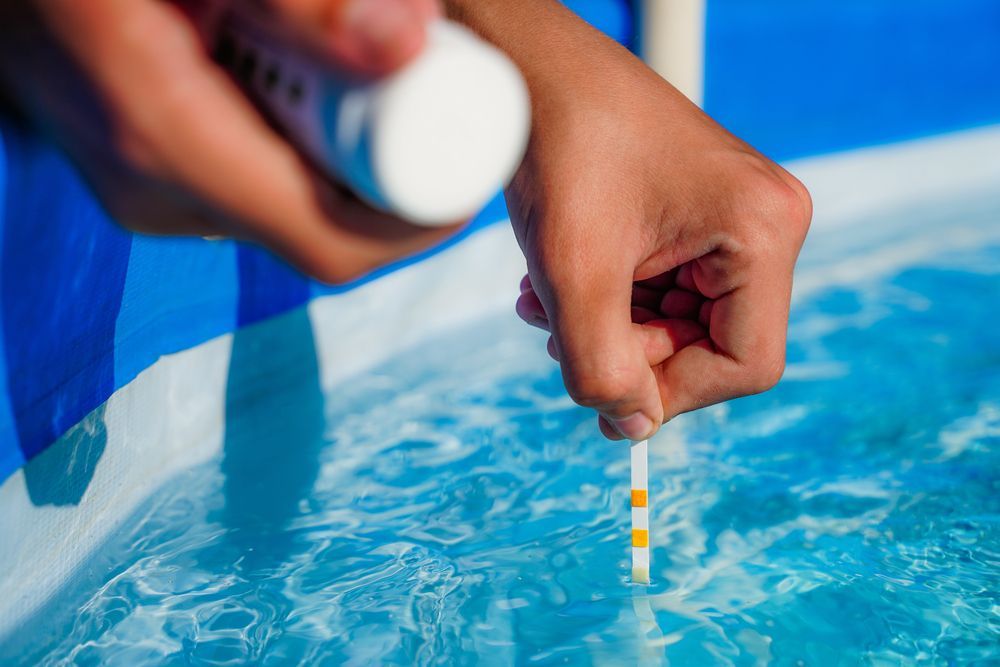
Home test strips are genuinely useful. For weekly pH and chlorine checks between services, a quality strip or liquid drop kit does the job, and liquid kits give more precise readings than strips. If you're learning how to test pool water at home, take your sample from elbow depth, away from return jets and skimmers, and test at the same time each week.
Strips have limits, though. They read only a few parameters, deteriorate in humid storage, and colour matching varies from person to person.
Professional testing uses digital equipment and calibrated instruments to measure a far broader range, including phosphates, stabiliser, metals and salt. A trained technician then interprets the results and tells you exactly what to add.
The test strips vs professional water test question isn't either-or. Use home checks weekly, and book a full professional test monthly or whenever your results look unusual.
What To Do With Your Test Results
Adjust in the right order: alkalinity first, then pH, then chlorine, because each one affects the next. Make small corrections, circulate for several hours, then retest.
For example, say your alkalinity is in range, but your test after a hot week shows pH at 8.0 and chlorine barely registering. Bring the pH down first, circulate and retest, then raise the chlorine. Adding chlorine first wastes much of it, because high pH weakens chlorine.
Infrequent testing is one of the most common pool cleaning mistakes that could be costing you, and guessing at doses often creates a second imbalance. Once you have your results, our guide on understanding the chemicals your pool needs explains which product corrects each reading. If results fluctuate unexpectedly or keep drifting out of range, bring a sample in so we can identify the cause.
When To Hand Water Testing To A Professional
Hand it over when your readings don't make sense or you'd rather not think about it at all. Professional pool water testing in Coffs Harbour replaces guesswork with specific instructions and prevents unnecessary chemical purchases.
Holiday Coast Pools & Water offers in-store and on-site water testing. Bring a sample in and we'll tell you exactly what your pool needs, supply the right chemicals and recommend equipment replacement where necessary. If you'd like the task off your list entirely, HCPW includes testing in every scheduled pool cleaning visit, so your water gets checked and corrected without you lifting a strip.
Frequently Asked Questions
How often should I test my pool water?
Test weekly from spring through autumn and fortnightly in winter, plus within 24 hours of heavy rain, a storm or a busy pool day. A monthly professional test catches readings home kits miss.
What does a pool water test measure?
A complete test measures pH, free chlorine, total alkalinity, calcium hardness and stabiliser, plus salt in saltwater pools. Professional testing also detects phosphates and metals.
Can I test my pool water myself, or should I bring a sample in?
Both work best together. Home strips or liquid kits suit weekly pH and chlorine checks. Bring a sample in monthly, or whenever results look odd, for a full, accurate reading and advice on what to add.
Do I need to test after rain or a storm?
Yes. Heavy rain dilutes chlorine, stabiliser and salt and washes in organic matter. Test within 24 hours of any significant storm, even if the water looks clear.
What should my pool's pH and chlorine levels be?
Aim for a pH of 7.2–7.6 and free chlorine of 1–3 ppm. Keep pH in range first, because chlorine loses effectiveness when pH runs high.
How long does a professional water test take?
Professional testing gives quick, accurate results, so you can adjust your water straight away. Bring your sample in a clean container, taken from elbow depth away from the return jets.
Book Pool Water Testing And Servicing In Coffs Harbour
Regular testing is the simplest way to keep your pool clear, comfortable and cheap to run. Holiday Coast Pools & Water is locally owned and has supported pool owners across Coffs Harbour, Woolgoolga, Sawtell, Urunga, Bellingen and Nambucca Heads for more than 30 years. Book our Coffs Harbour pool cleaning service and water testing comes included in every visit. Visit us at 1/40 Marcia St or call us today on (02) 6651 1940.